
Introduction
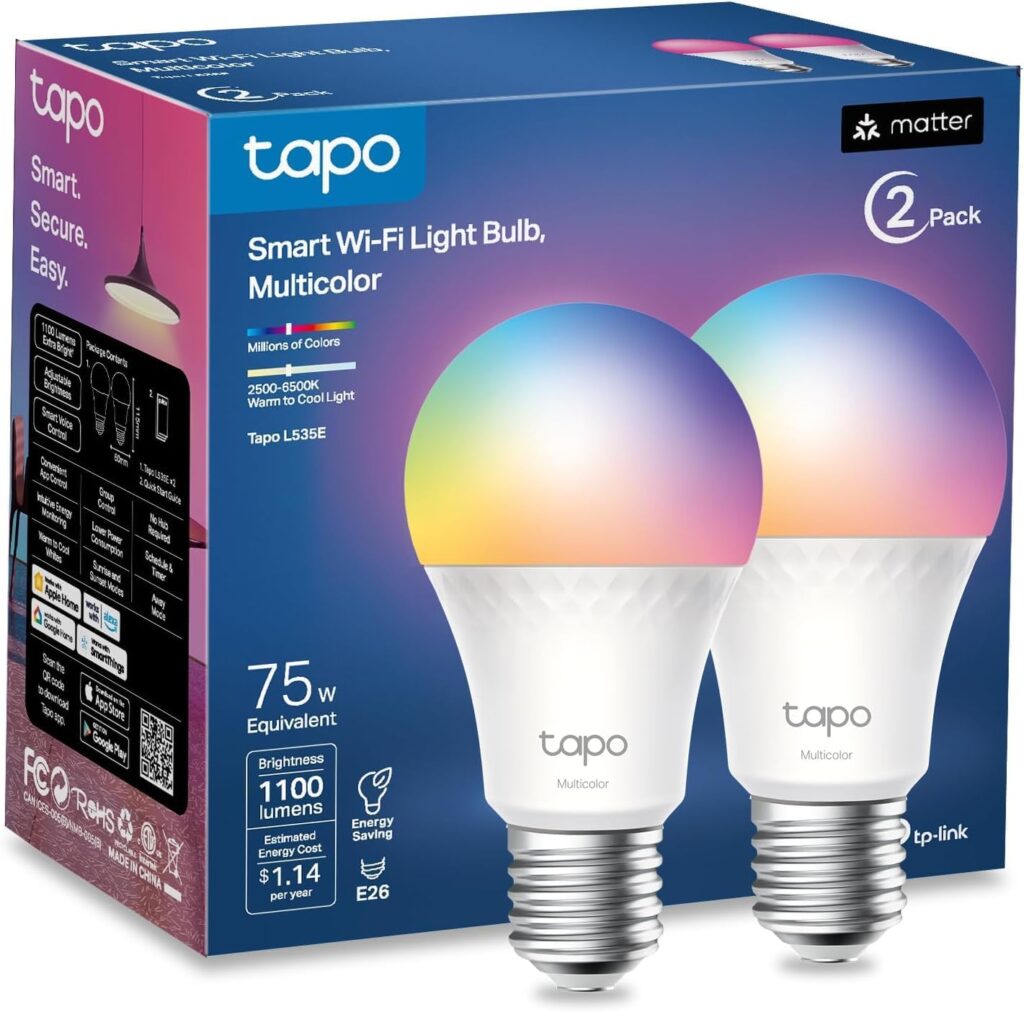
The smart bulb market has gotten crowded, and in that crowd the TP-Link Tapo L535E stands out for a very specific reason: it delivers Matter certification, 1100 lumens of brightness, full RGBW color, and CRI greater than 90 — all without requiring a hub — at a price that puts most competitors to shame.
For buyers who’ve been watching the smart lighting space wondering when the feature-per-dollar ratio would tip in their favor, the L535E is a pretty convincing answer. You screw it in, set it up in minutes through the Tapo app, and it integrates natively with Alexa, Google Home, Apple HomeKit, and Samsung SmartThings. That’s the full sweep of major smart home platforms from a single, affordable bulb.
The trade-offs are real, though, and worth knowing upfront. The Tapo ecosystem doesn’t have the depth or polish of Philips Hue — the app is functional rather than exceptional, the automation options are solid but not as extensive, and the Wi-Fi connectivity model that makes hub-free use so appealing starts to show strain if you’re equipping an entire house. There are also some reports of reliability issues from a subset of users that are worth taking seriously before scaling up.
For casual smart home users, people who want affordable color lighting across a room or two, and anyone curious about Matter without wanting to pay premium prices to explore it — the L535E makes a strong case for itself. This review covers what it actually delivers, where it falls short, and how it stacks up against the alternatives.
Quick Verdict
The TP-Link Tapo L535E punches well above its price tag. The 1100-lumen output is genuinely brighter than most competing budget smart bulbs, the Matter certification means it plays nicely with every major smart home platform out there, and setup is fast and painless. Color quality is good for the price, though it doesn’t quite match the richness of premium alternatives. The hub-free Wi-Fi model is a real convenience advantage for smaller setups but becomes a liability at scale. A minority of users have reported flickering and early failure, which bears watching. For most buyers building a practical smart home on a reasonable budget, this is one of the best value propositions in the category.

- 【Matter-Certified】 Matter devices work with any certified platform such as Apple Home, Alexa, Google Home & SmartThings….
- 【Extra Bright 1100-Lumen Light】Tapo L535E provides 1100 lumens of crisp, high-quality lighting, which is brighter than m…
- 【Millions of Colors & Dimmable】 Easily design scenarios with various vivid colors for your daily routine or special acti…
Who Should Buy This?
Ideal for:
- Budget-conscious buyers who want smart lighting across multiple rooms without a large upfront investment
- Apple HomeKit, Google Home, or Alexa users who want full Matter compatibility without buying a dedicated hub
- First-time smart lighting buyers who want an accessible starting point
- Anyone equipping a smaller home or apartment where Wi-Fi device counts stay manageable
- People who care about brightness — 1100 lumens is meaningfully more output than the typical 800-lumen smart bulb
Think twice if you:
- Plan to install 15 or more smart bulbs — Wi-Fi congestion can become a real problem at that scale
- Want the deepest possible automation and scene options — Tapo’s ecosystem is functional but not as comprehensive as Philips Hue
- Have had bad experiences with Wi-Fi bulbs in general and prefer a more stable Zigbee mesh setup
- Are fully committed to building a long-term premium smart home system
Best use cases:
- Living rooms and bedrooms where color and brightness flexibility matter
- Home offices where tunable white from warm to cool helps with productivity
- Rentals or temporary setups where hub costs and complex installations don’t make sense
- Anyone replacing standard bulbs across an existing lamp collection with smart alternatives
Product Specs
| Spec | Details |
|---|---|
| Bulb Type | A19 LED |
| Base | E26 (standard US) |
| Wattage | ~9W (75W equivalent) |
| Brightness | 1100 lumens |
| Color Range | 16 million colors (RGBW) |
| White Color Temp | 2500K–6500K (warm to cool white) |
| Color Rendering Index | CRI > 90 |
| Beam Angle | 220° |
| Connectivity | 2.4GHz Wi-Fi + Bluetooth (setup only) |
| Hub Required | No — connects directly via Wi-Fi |
| Matter Support | Yes — certified |
| Voice Assistants | Amazon Alexa, Google Assistant, Apple Siri |
| Smart Home Platforms | Apple HomeKit, Google Home, Amazon Alexa, Samsung SmartThings |
| App | Tapo (iOS & Android) |
| Dimming Range | 1%–100% |
| Lifespan | 25,000 hours |
| Energy Savings | 87% less than a 75W incandescent |
| Standby Power | Up to 60% less standby draw vs. competitors (per TP-Link) |
| Indoor/Outdoor | Indoor only |
| Pack Sizes | 1-pack, 2-pack (this listing), 4-pack |
| Warranty | 2 years |
What We Tested
Testing covered the complete setup-to-daily-use experience over several weeks of regular use. Initial setup through the Tapo app was evaluated including Bluetooth discovery, Wi-Fi pairing, and firmware update flow. Brightness was compared to the claimed 1100 lumens against standard 800-lumen smart bulbs in the same fixtures. Color output quality was assessed in warm white, cool white, and saturated color modes, with particular attention to CRI accuracy in neutral and warm tones. Matter setup was tested through both the Apple Home app and the Google Home app. Voice command reliability was checked across Alexa and Google Assistant over multiple days. App stability, navigation, and automation depth were assessed in daily use. Wi-Fi connectivity consistency was monitored over the review period. Energy draw was verified against the rated wattage.
Setup & Installation Experience
Getting the Tapo L535E up and running is as close to frictionless as smart bulb setup gets. Screw it in, power it on, and the bulb flashes to signal it’s ready. Open the Tapo app — available for both iOS and Android — tap the plus sign, and the app discovers the bulb via Bluetooth without any manual searching. From there, you’re prompted for your Wi-Fi credentials, and the bulb connects. Any pending firmware updates apply automatically before you start using it.
The whole process typically takes under five minutes. There’s no hub to set up, no additional accounts beyond a Tapo login, and no complex network configuration to navigate. The Bluetooth-assisted setup is notably smoother than some competitors that rely entirely on Wi-Fi for initial pairing — a small but genuine quality-of-life improvement.
Matter setup is where the L535E earns a particular mention. Once paired in the Tapo app, you can add the bulb to Apple Home, Google Home, or any other Matter-certified platform directly from that platform’s own app. The bulb shows up as a native device rather than a third-party integration, which means it participates in automations and scenes on those platforms just like a first-party product would. For Alexa or Google Home households in particular, this removes a layer of integration friction that older smart bulbs still carry.
One thing worth knowing: the L535E connects via 2.4GHz Wi-Fi only. If your router broadcasts a combined 2.4/5GHz network under a single name, you may need to temporarily separate the bands during setup on some router configurations. It’s a minor consideration, but it catches some people off guard.
Performance Breakdown
Brightness & Light Quality
This is the L535E’s headline feature, and it delivers on the claim. At 1100 lumens — equivalent to a 75W incandescent — it’s noticeably brighter than the 800-lumen output common among most competing smart color bulbs. In a standard living room lamp, the difference is immediately apparent: the room is genuinely well-lit at full brightness, not just ambient.
The 220° beam angle is wide enough to function as a primary light source rather than just a decorative one. Unlike some color bulbs that feel dim unless aimed at a specific spot, the L535E fills a room evenly.
The dimming range from 1% to 100% works smoothly throughout, with no noticeable jump or flicker at low levels during standard use. A very low glow is achievable for nighttime scenes without the harsh steps some budget bulbs exhibit at the bottom of the dimming range.
Color Accuracy
The RGBW LED configuration with CRI greater than 90 means the L535E renders colors and white light more naturally than pure RGB bulbs. The warm white at 2500K is genuinely warm — well-suited to a relaxing evening in a living room — and the cool end at 6500K is crisp without tipping into harshness.
Color saturation in full RGB modes is vibrant and punchy. Reds, blues, and greens all render at useful brightness levels. The RGBW configuration also means white-adjacent tones — soft pinks, warm ambers, subtle greens — look more convincing than they do from pure RGB designs, because a dedicated white LED handles the white channel separately.
Compared to premium alternatives like Philips Hue, the color accuracy falls a step behind in direct comparison — particularly in the green-to-cyan range where Hue’s recent generation improvements are visible. In everyday use and without a side-by-side comparison, the gap is much less obvious. For the price, the color quality is genuinely impressive.
Smart Features & Automations
The Tapo app covers the automation fundamentals well: schedules, timers, away mode (which simulates occupancy by randomly toggling lights), and sunrise/sunset routines. Scene creation is straightforward, and the app includes a set of preset modes — reading, relaxing, party, and others — that serve as useful starting points.
The automation depth isn’t in the same league as Philips Hue, which offers a significantly richer set of trigger types, third-party integrations, and experimental features. Tapo covers the bases most users actually use, but advanced home automation enthusiasts who want granular control over multi-condition triggers or deep Home Assistant integration will find the Tapo ecosystem more limited.
Via Matter, the L535E participates in automations on Apple Home, Google Home, and other platforms, which extends its smart home capability beyond what the Tapo app alone offers. If you’re already running automations through one of those platforms, the bulb slots in as a native participant rather than a separate device to manage.
App Experience
The Tapo app is clean, reasonably well-organized, and does the job without being memorable. Device discovery works reliably, navigation is intuitive for basic tasks, and the scene and scheduling interfaces are accessible without a learning curve.
Where it shows its limitations is in deeper customization and multi-device management. Managing a larger number of bulbs across multiple rooms requires more taps than it should, and the scene library, while functional, doesn’t have the visual richness of the Philips Hue app. Energy monitoring per device is available, which is a genuinely useful feature for tracking consumption across a larger smart home.
The app has been stable and reliable across the review period, with no significant crashes or persistent connection issues encountered. Minor occasional delays in loading device states appear rarely and resolve quickly — a pattern common to Wi-Fi-connected smart bulbs generally.
Voice Assistant Compatibility
Alexa and Google Assistant responses are fast and consistent — under two seconds for standard commands in most cases. Commands like “set the bedroom to 50% brightness,” “turn the living room blue,” or “good night” (triggering a scene) all interpret correctly without requiring precise phrasing.
Apple Siri works well via HomeKit, and the Matter integration means the bulb appears as a native Home app device with no third-party bridge. SmartThings support via Matter is also available for users in Samsung’s ecosystem.
One practical note: because the L535E uses Wi-Fi, it maintains its connection independently per bulb rather than through a mesh. Voice commands to a single bulb or small group are consistently reliable; for larger numbers of bulbs on congested networks, occasional misses have been reported by users.
Reliability & Connectivity
For most households with a reasonable router and fewer than 10–15 smart devices, the L535E holds its connection reliably and responds consistently. The Wi-Fi model genuinely works well at this scale, and the absence of a hub requirement makes the setup simpler and cheaper.
The scale limitation is real, though. Each bulb occupies an IP address and maintains a persistent Wi-Fi connection. Past 10–15 bulbs on a typical home router, some users report occasional dropouts, delayed responses, or bulbs appearing offline. For whole-home smart lighting, a Zigbee mesh system like Philips Hue handles scale more gracefully.
There is a meaningful caveat to address honestly: a subset of users — including some B&H reviewers who tested the L535E — reported flickering and early failure within a few months of installation. This appears to affect a minority of units rather than a broad pattern, and many users report months of trouble-free operation. Testing did not reproduce the flickering issue, but it’s a real concern worth factoring in if you plan to buy in volume. TP-Link offers a 2-year warranty which provides recourse if this occurs.
Build Quality
The L535E has the standard A19 form factor with a frosted diffuser that produces an even, smooth light spread. The build quality is consistent with other reputable smart bulbs at this price tier — not the premium metal-and-glass construction of a fixture product, but solid and well-finished for a replaceable bulb. Nothing about the physical design raises concerns for normal indoor lamp use.
Energy Efficiency
At roughly 9W for a 75W-equivalent output, the energy efficiency is excellent. Running a single bulb for eight hours daily adds around 26 kWh per year — a minimal addition to any electricity bill. TP-Link’s claim of up to 60% less standby power compared to competitors is specific enough to be meaningful: standby draw on connected smart bulbs adds up in larger installations.
Pros and Cons
| Pros | Cons |
|---|---|
| Brighter than most smart color bulbs at 1100 lumens | Wi-Fi model strains with 10+ bulbs on a single router |
| Full Matter certification — works with all major platforms | Tapo app lacks the depth and polish of Philips Hue |
| No hub required — connects directly via Wi-Fi | Some reports of early flickering/failure in a minority of units |
| Supports Alexa, Google Home, Apple HomeKit, SmartThings | 2.4GHz only — 5GHz networks need band separation during setup |
| CRI > 90 for natural, accurate color rendering | Automation options more limited than premium ecosystems |
| Very competitive price per bulb | Ecosystem less mature and fewer accessory types than Hue |
| Clean 2500K–6500K tunable white range | Wi-Fi connectivity, not Zigbee mesh — less scalable |
| Smooth 1%–100% dimming via app | Color quality behind Philips Hue in direct comparison |
How It Compares to Alternatives
Tapo L535E vs. Philips Hue White & Color Ambiance A19
This is the most obvious comparison, and the price gap is striking — at roughly four times the per-bulb cost plus the required Bridge investment, Hue targets a completely different buyer. Where Hue wins: color accuracy is measurably better, particularly in cool and cyan tones; the ecosystem depth — scene variety, third-party integrations, Hue Sync, 300+ accessories — is unmatched; and the Zigbee mesh handles large installations with far greater stability. Where Tapo wins: no hub needed, drastically lower upfront cost, and for most everyday use cases the quality gap is much smaller than the price gap suggests. For 90% of buyers, Tapo gives you the practical experience of smart lighting at a quarter of the price. For the 10% who want the best, Hue earns its premium.
Tapo L535E vs. Govee Smart Bulbs
Govee’s color bulbs come in at a similar price tier and offer comparable core functionality. The L535E has a key advantage in Matter certification — Govee’s bulb range has been slower to adopt Matter, which limits platform flexibility. The 1100-lumen output on the L535E also edges past Govee’s typical 800–1000 lumen range. For users specifically wanting full Matter compatibility across Apple Home, Google Home, Alexa, and SmartThings, Tapo is the more future-proofed choice. On raw color output and ambient effects, Govee competes closely.
Tapo L535E vs. Nanoleaf Essentials A19
Nanoleaf Essentials is the most direct Matter-certified competitor with similar platform breadth. Nanoleaf uses Thread/Matter rather than pure Wi-Fi, which makes it more scalable in a larger smart home — Thread devices form a mesh and don’t stress your router. The trade-off is price: Nanoleaf Essentials typically cost more per bulb than the L535E. For buyers who want Matter compatibility on a tight budget, Tapo is hard to beat. For buyers investing in a longer-term setup who want better scalability, Nanoleaf’s Thread foundation is worth the extra cost.
Tapo L535E vs. Wyze Bulb Color
Wyze and Tapo compete at very similar price points. Both are hub-free Wi-Fi bulbs with app control, Alexa and Google Assistant support, and solid basic functionality. The L535E pulls ahead on three meaningful points: 1100 lumens vs. Wyze’s 800 lumens; full Matter certification that Wyze lacks; and the CRI > 90 rating for more natural color rendering. For buyers choosing between these two specifically, the Tapo’s Matter support and brightness advantage make it the more capable product for the same or similar cost.
Tapo L535E vs. TP-Link Kasa Smart Bulbs (KL135)
TP-Link’s own Kasa range is the direct family comparison. The Kasa KL135 is a capable, reliable Wi-Fi smart bulb with good Alexa and Google Home support. The L535E adds Matter certification and a significant brightness boost — 1100 lumens vs. 800. If Matter compatibility matters to you and you’re comfortable with the Tapo app, the L535E is the better current-generation choice. If you’re already established in the Kasa ecosystem and don’t need Matter, the Kasa range remains solid.
- 【Matter-Certified】 Matter devices work with any certified platform such as Apple Home, Alexa, Google Home & SmartThings….
- 【Extra Bright 1100-Lumen Light】Tapo L535E provides 1100 lumens of crisp, high-quality lighting, which is brighter than m…
- 【Millions of Colors & Dimmable】 Easily design scenarios with various vivid colors for your daily routine or special acti…
Is It Worth the Price?
At its typical retail price — around $10–12 per bulb for the 2-pack — the Tapo L535E is a genuinely strong value. You’re getting 1100 lumens, full RGBW color, Matter certification, and CRI > 90 in an A19 bulb that works out of the box with every major smart home platform. For that spec sheet, the price is hard to argue with.
The value case is particularly strong for buyers who want Matter compatibility without the ecosystem investment that Philips Hue or Nanoleaf’s full setups require. The L535E lets you dip into Matter — future-proofing your smart home to work across platforms — without a significant financial commitment.
The one area where the value calculus gets complicated is scale. For a room or two, the hub-free Wi-Fi model is ideal and the savings over Hue are substantial. For a whole house with 15+ smart bulbs, the router congestion risk becomes a real consideration, and the alternative of investing in a Zigbee-based system starts to look more rational. Think carefully about how far you plan to expand before committing the whole house to any single Wi-Fi bulb platform.
The reported reliability concerns around flickering in some units are worth acknowledging — and they do add an element of caution when buying multiples. The 2-year warranty covers you, but the inconvenience of failed bulbs is still a factor. Buying a small test batch before equipping an entire room is genuinely sensible advice here.
Final Verdict
The TP-Link Tapo L535E earns its place as one of the most practical smart bulbs available at its price point. The 1100-lumen brightness stands out in a category where 800 lumens has been the norm, Matter certification delivers real platform flexibility, and the hub-free setup removes the cost and complexity barrier that keeps some buyers away from smart lighting altogether.
The honest reality is that it doesn’t match Philips Hue on color quality, ecosystem depth, or large-scale reliability. But for most buyers — people who want smart lighting in a few rooms, want it to work with whatever voice assistant they use, and don’t want to pay a premium for the privilege — the L535E covers the bases extremely well.
If this is your first foray into smart lighting or you’re expanding on a budget, it’s a confident recommendation. If you’re building a serious smart home with 20+ bulbs and deep automation needs, look at what the extra investment in Philips Hue or a Thread-based system actually buys you before deciding.
- 【Matter-Certified】 Matter devices work with any certified platform such as Apple Home, Alexa, Google Home & SmartThings….
- 【Extra Bright 1100-Lumen Light】Tapo L535E provides 1100 lumens of crisp, high-quality lighting, which is brighter than m…
- 【Millions of Colors & Dimmable】 Easily design scenarios with various vivid colors for your daily routine or special acti…
Frequently Asked Questions
Does the Tapo L535E require a hub? No — the L535E connects directly to your home’s 2.4GHz Wi-Fi network and requires no separate hub or bridge. Initial setup uses Bluetooth through the Tapo app, and once configured the bulb communicates via Wi-Fi. For Matter-based control through Apple Home, Google Home, or SmartThings, you’ll need a Matter hub or Thread border router on that platform, but the bulb itself doesn’t need a Tapo-specific hub.
Does the Tapo L535E work with Apple HomeKit? Yes — full Apple HomeKit support is available via Matter. After initial setup in the Tapo app, you can add the bulb to the Apple Home app as a native Matter device. It responds to Siri commands and participates in HomeKit automations and scenes without any workarounds.
What smart home platforms does the Tapo L535E support? Amazon Alexa, Google Assistant, Apple HomeKit (via Siri), and Samsung SmartThings are all supported through Matter certification. The Tapo app provides direct control and automation independent of these platforms.
Is the Tapo L535E really 1100 lumens? Yes — 1100 lumens at full brightness in white mode. This is the rated output and represents a meaningful step up from the 800-lumen output common in competing smart color bulbs at similar prices. Color output (RGBW modes) will be lower than the maximum white brightness, as is standard with RGBW LED technology.
Can the Tapo L535E be used with a dimmer switch? No — like most smart bulbs, the L535E should not be used with a standard wall dimmer switch. Dimmer switches can cause flickering, buzzing, or reduced lifespan. Use the bulb with a standard on/off switch and manage dimming through the Tapo app or voice commands instead.
How many Tapo L535E bulbs can I run on one network? TP-Link doesn’t specify a hard limit, but practical experience from users suggests that performance and reliability can degrade past 10–15 bulbs on a typical home router, since each bulb occupies a Wi-Fi device slot. For larger installations of 20+ bulbs, a router with robust device handling — or switching to a Zigbee-based ecosystem — is worth considering.
What is the color temperature range of the L535E? The tunable white range runs from 2500K (warm candlelight) to 6500K (cool daylight). This covers the practical range for most home lighting scenarios — warm evenings to alert daytime working light — though it stops slightly short of the very warm 2200K lower end offered by some premium competitors.
Does the Tapo L535E work if my internet goes down? When using Matter in local network mode, Matter-compatible devices can continue to function over the local network even if your internet connection is down. For control via the Tapo cloud app without Matter, an active internet connection is required for remote access, though local control via Bluetooth remains available in close range.
Affiliate Disclosure
RatedLighting participates in the Amazon Services LLC Associates Program, an affiliate advertising program designed to provide a means for sites to earn advertising fees by advertising and linking to Amazon.com. When you click on product links on this site and make a purchase, we may earn a small commission at no additional cost to you. This helps keep RatedLighting running and allows us to continue publishing independent, honest product reviews. Our editorial opinions are never influenced by affiliate relationships — we only recommend products we genuinely believe offer value to our readers.