
Introduction
If you’ve been building out a Philips Hue setup indoors and wondering how to carry that same quality into your garden, the Hue Lily Outdoor Spot Light is the obvious first step. Launched back in 2018 and refined since, the Lily has become the benchmark by which pretty much every outdoor smart spotlight gets measured — and that reputation has held up.
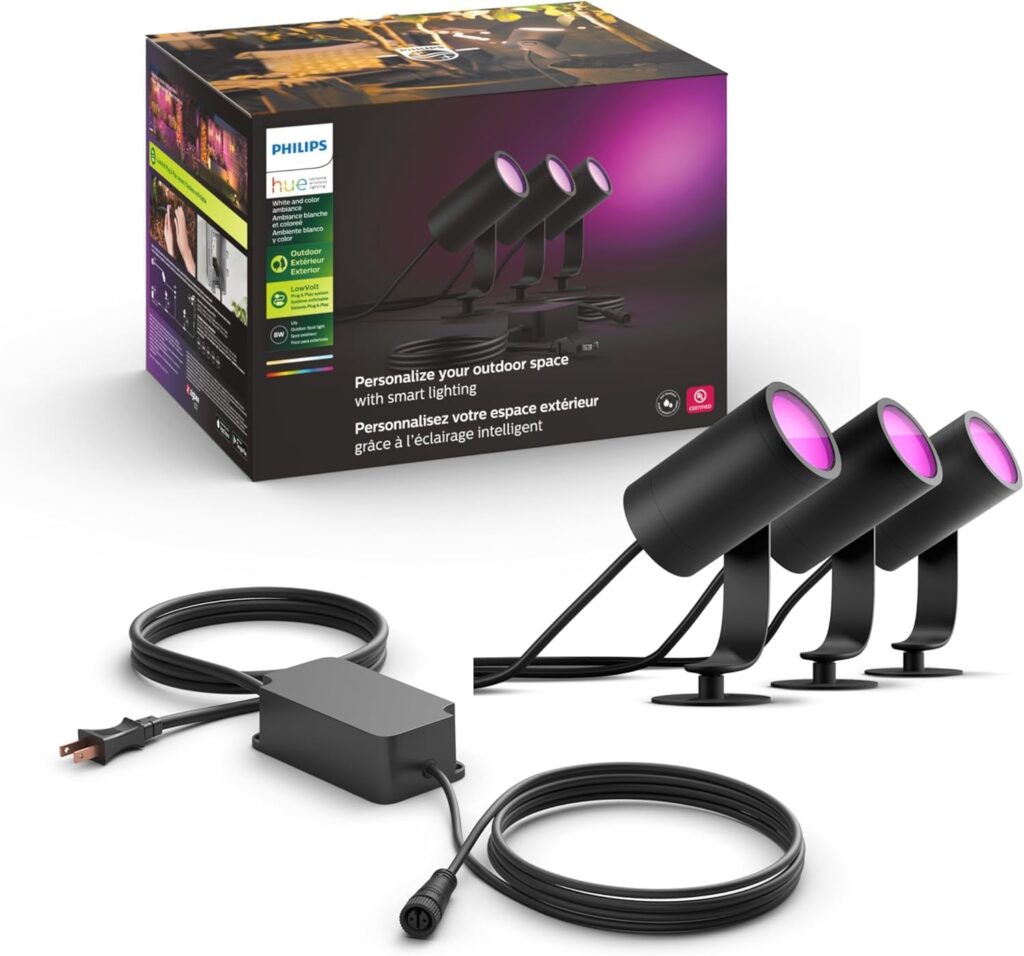
This is the 3-pack base kit: three 8W outdoor spotlights, a 40W power supply, all the cables and connectors you need to get started, and deep integration with the full Hue ecosystem. You point them at trees, walls, shrubs, or architectural features, and what comes back is 16 million colors rendered with a richness that cheaper alternatives genuinely struggle to match.
But let’s be upfront about the trade-offs. These are expensive lights. The Hue Bridge is not included and is required to use them at all — there’s no Bluetooth fallback for Hue’s outdoor range. The IP65 rating, while solid, is a step below what some competitors now offer. And at 600 lumens per spot, this is accent and mood lighting territory, not functional illumination for a dark driveway.
For anyone already in the Hue ecosystem — or anyone who genuinely wants the best color quality available in an outdoor smart spotlight — the Lily earns its place. For buyers starting from scratch who aren’t sure about the ecosystem cost, there are real questions to answer before committing.
Quick Verdict
The Philips Hue Lily Outdoor Spot Light 3-pack is the most complete and best-performing smart landscape lighting kit available for the price bracket it occupies. Color accuracy is excellent, ecosystem integration covers every major platform including Apple HomeKit, the system is expandable without limitation, and real-world reliability over multiple seasons has been confirmed by long-term users. The cost of entry is high — both for the kit itself and the required Hue Bridge — and brightness falls short of floodlight expectations. For accent lighting in an established Hue setup, though, there’s very little that touches it.

- WHAT’S IN THE BOX: Includes three 8W outdoor smart path lights, two T connectors, three 16-foot extension cables, three …
- REQUIRES A HUE BRIDGE: Unlock the power of Hue and enjoy automations, control your outdoor spotlight from anywhere in th…
- MILLIONS OF COLORS: Paint your outdoors with 16 million colors; unwind with warm to cool white light; illuminate any out…
Who Should Buy This?
Ideal for:
- Existing Philips Hue users who want to extend their ecosystem outdoors
- Apple HomeKit households that need outdoor smart lighting with native integration
- Anyone prioritizing color quality and ecosystem polish over raw brightness
- Homeowners wanting a premium, expandable outdoor lighting system built to last
- People who sync their lights to music, movies, or seasonal scenes
Think twice if you:
- Don’t yet own a Hue Bridge — budget for that additional cost upfront
- Need functional security or pathway lighting — 600 lumens is atmospheric, not practical for dark spaces
- Are starting your smart home fresh and aren’t committed to the Hue ecosystem
- Have outdoor power outlets far from where lights need to go — extension cords are not officially recommended
- Are comparing purely on price per spotlight
Best use cases:
- Uplighting trees, hedges, and garden features for dramatic evening effect
- Illuminating exterior walls and architectural details in color
- Holiday and seasonal decoration with automated scene changes
- Patio and entertainment areas tied to Hue Sync for music or movie lighting
- Long-term, whole-garden setups built up gradually with extension kits
Product Specs
| Spec | Details |
|---|---|
| What’s in the Box | 3x 8W spotlights, 2x T-connectors, 3x 16-ft extension cables, 3x ground spikes, 1x 40W power supply |
| Wattage | 8W per spotlight (24W total) |
| Brightness | Up to 600 lumens per spotlight |
| Color Range | 16 million colors — White & Color Ambiance |
| White Color Temp | Warm to cool white (2000K–6500K approx.) |
| Connectivity | Zigbee (via Hue Bridge) |
| Bluetooth Fallback | No — Bridge required for all operation |
| Hub Required | Yes — Hue Bridge (sold separately) |
| Voice Assistants | Amazon Alexa, Google Assistant, Apple Siri/HomeKit |
| Smart Home Platforms | Apple HomeKit, Google Home, Amazon Alexa, Samsung SmartThings |
| Matter Support | Yes — via Hue Bridge |
| App | Philips Hue (iOS & Android) |
| Weatherproofing | IP65 (dust-tight, water jet resistant) |
| Operating Temperature | -20°C to 40°C (-4°F to 104°F) |
| Casing Material | Metal (steel) |
| Installation | Ground spike or surface mount |
| Extendable | Yes — with Lily Extension kits |
| Power Source | Low-voltage wired (AC power supply included) |
| Warranty | 2 years |
| Indoor/Outdoor | Outdoor only |
| Dimmable | Yes, full range via app or voice |
What We Tested
Testing spanned the full setup-to-daily-use arc. Initial setup was assessed from unboxing through Bridge pairing and first scene, including both the Hue app onboarding flow and Apple HomeKit pairing. Brightness and color output were evaluated in a garden bed, against a light-colored exterior wall, and with spotlights aimed at tree canopy from ground level. Color accuracy was compared against earlier observations of budget alternatives. Scene modes and Hue-specific automation features — geofencing, sunset routines, Hue Sync — were tested over multiple evenings. Voice assistant responsiveness was checked across Alexa, Google Assistant, and Siri. Weather performance was passive, leaving lights installed through rain, cold, and ambient humidity. Build quality and cable management were assessed during installation and over time.
Setup & Installation Experience
The Lily base kit is designed for people who want to set things up once and forget about them. The box contains everything needed to run three spotlights from a single power supply: three 16-foot extension cables, two T-connectors for daisy-chaining the lights, three ground spikes, and the 40W power supply itself. No tools required for the ground installation — push the spike, connect the cable, done.
For a surface mount on decking or a wall, you’ll need a drill and a few minutes, but the hardware is included. Both mounting styles give a clean, professional result.
The quick-connect cable system makes linking the spotlights together genuinely straightforward — you clip the lights in sequence, run the cable back to the power supply, and plug into a standard outlet. The only thing worth planning ahead is outlet proximity. Philips doesn’t recommend extension cords with this system, so you’ll want a weatherproof outdoor outlet reasonably close to your intended placement area.
Pairing is done through the Philips Hue app, which walks you through adding each light to a room and naming it. Apple HomeKit pairing is done via a QR code on the Hue Bridge and takes about a minute. Alexa and Google Home integrate through their respective apps after the Hue setup is complete.
One hard requirement that catches some buyers off guard: the Hue Lily outdoor lights have no Bluetooth mode. Unlike some Hue indoor products, the Lily works exclusively through the Hue Bridge — there’s no fallback control option. If you don’t already own a Bridge, that’s an additional purchase of around $60 to factor in.
Performance Breakdown
Brightness & Light Quality
At around 600 lumens per fixture, the Lily’s output felt modest at first glance — but in practice, the lights covered a surprisingly large section of exterior wall, and three spotlights together created a genuinely striking ambient wash across a garden.
The key context: these are accent spotlights, not floodlights. They’re built to highlight features, not illuminate a dark area for practical use. Aimed at a mature tree from a couple of meters away, a single spotlight throws color up through the canopy in a way that looks expensive and intentional. Against a light-coloured exterior wall, three Lilys can light a substantial area with a rich, even wash.
The full 600 lumens is only achieved in white or warm white mode — shift to bolder saturated colors and brightness drops noticeably. This is a physical reality of LED color mixing and not unique to Hue, but it’s worth knowing if saturated reds or blues are part of the plan. The colors still look excellent; they’re just dimmer than the maximum white output.
Color Accuracy
This is where the Lily separates from the competition. Expert reviewers have described the color accuracy as museum-quality, and that’s not hyperbole. Hue’s LED array and the quality of the fisheye diffuser produce colors that are clean, saturated, and consistent across the whole output angle.
The fisheye diffuser creates a surprisingly wide spread, providing a good splash of color out to about 3 meters — enough to cover a full section of wall or illuminate a tree canopy well from ground level.
Blues are particularly impressive — a notoriously difficult color for RGB LEDs to render cleanly at useful brightness. Greens are vibrant without leaning yellow. The warm-to-cool white range is equally capable, making these lights as useful for clean task-adjacent lighting as for atmospheric color scenes.
Smart Features & Automations
The Lily integrates fully with the Hue app’s complete automation suite. Sunset and sunrise routines work reliably, geofencing triggers work consistently with the Bridge connection, and Hue Sync — which maps your lights to music or screen content — extends to outdoor zones for a genuinely immersive effect during outdoor movies or garden parties.
The Bridge handles up to 50 lights, so the Lily base kit is just the starting point. Extend with additional Lily kits or Lily XL singles, mix in Calla pathway lights or Econic bollards, and the whole garden can operate as a unified system from a single app.
Third-party integration through the Hue Bridge API remains one of the most mature in smart lighting — Home Assistant, IFTTT, and SmartThings all connect reliably, giving advanced users significant automation flexibility.
App Experience
The Philips Hue app is the most polished in the smart lighting space. Scene creation is visual and intuitive, room grouping is flexible, and the automation interface makes building schedules and geofencing routines accessible without technical expertise. Hue Labs offers additional experimental features — candle flicker, natural wake-up effects, and others — that add genuine variety.
Occasional momentary disconnections from the Bridge have been reported by some users, typically resolving themselves quickly. These are rare rather than routine, and the underlying Zigbee connectivity is considerably more stable than Wi-Fi-based alternatives in dense environments.
Voice Assistant Compatibility
Alexa, Google Assistant, and Apple Siri all work well, with response times consistently under two seconds for basic commands. The Apple HomeKit integration is native and tight — the lights appear in the Home app, respond to Siri, and participate in HomeKit automations and scenes without any workarounds.
Samsung SmartThings pairing is also supported, making the Lily one of the most broadly compatible outdoor smart lights available across all the major home automation platforms.
Reliability & Connectivity
Having tested through multiple seasons of rain, heat, and UV exposure, the Lily has proven reliable outdoors without degradation. Users in cold climates including Minnesota report the lights performing flawlessly through subzero temperatures.
The IP65 rating means full dust protection and resistance to water jets from any angle — more than adequate for rain, sprinklers, and British winters, though a step below the IP67 rating some newer competitors have introduced. For most residential garden applications, IP65 is sufficient.
Zigbee connectivity via the Bridge is meaningfully more stable than Wi-Fi alternatives in multi-device setups. The mesh nature of Zigbee means range extends as you add more lights — a practical advantage for larger gardens.
Build Quality
The Lily spotlights are built from metal, which is immediately apparent when you hold one. The quality of the lights and the ease of installation are high — a steel casing and quick-connect cable system that makes neat installation straightforward. These feel like fixtures designed for years of outdoor exposure, not seasonal decorations.
The rotating head allows precise aiming — a detail that matters when you’re trying to hit a specific feature at a specific angle. The fisheye lens is glass rather than plastic, contributing to the output quality as well as longevity.
Energy Efficiency
At 8W per spotlight, three Lily lights draw 24W in operation — modest for LED landscape lighting and even more so given the output quality. Running the 3-pack for 6 hours nightly adds around 53 kWh annually, well under $10 per year at average electricity rates in most regions. The 40W power supply has some overhead, but actual draw at moderate brightness is typically lower than the rated maximum.
Pros and Cons
| Pros | Cons |
|---|---|
| Best-in-class color accuracy for outdoor spotlights | Premium price — one of the most expensive options in the category |
| Native Apple HomeKit, Alexa, Google Home, SmartThings support | Hue Bridge required — no Bluetooth fallback for outdoor range |
| Extendable system — add lights progressively with extension kits | IP65 rating, not IP67 — slightly behind some newer competitors |
| Mature, polished Hue app with deep automation features | Extension cords not officially supported — outlet location matters |
| Matter compatible via Bridge for future-proof ecosystem | 600 lumens is accent-level, not functional outdoor illumination |
| Metal construction built for years of outdoor use | Bridge adds to total cost for new Hue users |
| Full Hue Sync support — lights sync with music and screen content | Color brightness drops noticeably compared to white mode |
| Expandable from 3-pack to whole-garden system | Older design — no refresh since original launch |
How It Compares to Alternatives
Philips Hue Lily vs. Govee Outdoor Spot Lights 2
This is the most natural head-to-head in the category. Govee delivers Matter support and 700-lumen output at roughly 40% of Hue’s price — and the IP67 rating on the Govee beats the Lily’s IP65. For buyers without a Hue Bridge or a preference for Apple HomeKit, Govee is a genuinely strong alternative. Where Hue Lily pulls ahead decisively is color quality, ecosystem depth, and Apple HomeKit support. If HomeKit integration matters to you at all, Govee isn’t an option. If it doesn’t, and budget is a consideration, Govee closes the gap more than the price difference suggests.
Philips Hue Lily vs. Philips Hue Lily XL
The XL variant pushes 1050 lumens at 15W per fixture — nearly double the brightness of the standard Lily for a significantly higher per-unit cost. Same ecosystem, same connectivity, same installation approach. If brightness is a priority and budget allows, the XL is worth the premium. For most accent lighting applications, though, the standard Lily’s 600 lumens is sufficient, and the smaller fixture blends more naturally into a garden setting.
Philips Hue Lily vs. Nanoleaf Outdoor Downlights
Nanoleaf’s outdoor range supports Thread/Matter and Apple HomeKit natively, giving them a genuine pitch for the Apple ecosystem. Color quality is competitive, and setup is straightforward. The Hue Lily’s advantages are ecosystem maturity — the breadth of Hue accessories, the integration depth with SmartThings and third-party tools, and the established long-term reliability track record. Nanoleaf is worth considering for Apple-first users who want to avoid the Bridge cost; for anyone who wants the most complete outdoor smart lighting setup, Hue’s ecosystem depth is hard to replicate.
Philips Hue Lily vs. LIFX Outdoor Downlight
LIFX requires no hub and offers good color quality, with HomeKit support that adds to the appeal. The trade-off is Wi-Fi connectivity — in larger installations, multiple Wi-Fi devices can strain a network in a way Zigbee mesh doesn’t. LIFX also doesn’t support Matter at the time of writing. For a compact setup prioritizing simplicity, LIFX is viable. For a growing system or anyone who values Matter compatibility and long-term platform flexibility, Hue wins.
Philips Hue Lily vs. Wyze Outdoor Lighting
Wyze’s outdoor lighting is primarily security-oriented — motion-triggered, camera-integrated, white light for visibility. The two products don’t compete directly on use case. If your goal is landscape feature lighting with color, Wyze isn’t a meaningful alternative. If you’re weighing functional outdoor lighting against decorative lighting, that’s a use case question, not a product comparison.
- WHAT’S IN THE BOX: Includes three 8W outdoor smart path lights, two T connectors, three 16-foot extension cables, three …
- REQUIRES A HUE BRIDGE: Unlock the power of Hue and enjoy automations, control your outdoor spotlight from anywhere in th…
- MILLIONS OF COLORS: Paint your outdoors with 16 million colors; unwind with warm to cool white light; illuminate any out…
Is It Worth the Price?
Honestly, the Lily is expensive — and that deserves a direct answer rather than a soft qualifier.
For buyers already in the Hue ecosystem, the answer is straightforwardly yes. Expert consensus has rated it the best smart outdoor lighting system available, earning a 9.2 out of 10 across multiple independent reviews. If you have a Bridge and know what Hue’s quality feels like indoors, extending that to the garden with the Lily is a natural and worthwhile investment. The color output, app experience, and platform compatibility are all exactly what you’d expect from the brand.
For buyers starting from scratch, the math requires more thought. The Lily 3-pack plus a Hue Bridge represents a significant upfront cost compared to alternatives. You’re paying for build quality, color accuracy, full HomeKit support, and an expandable system that will still be relevant and supported several years from now. Whether that premium is worth it depends on how seriously you’re building out a smart home and whether ecosystem longevity matters to you.
The one scenario where the value is trickier to justify: if you only want three spotlights, don’t plan to expand, and don’t use Apple HomeKit. In that case, a competitor like Govee offers most of the practical functionality at a fraction of the cost.
Final Verdict
The Philips Hue Lily Outdoor Spot Light base kit has been the standard for outdoor smart landscape lighting since it launched, and that hasn’t changed. Color quality remains unmatched at this price tier, the ecosystem integration covers every major platform, and real-world reliability through multiple outdoor seasons backs up the premium positioning.
The honest weaknesses are the cost — both for the kit and the mandatory Bridge — and a brightness ceiling that puts this firmly in the accent lighting category. Neither of those should surprise anyone going in; the product was never marketed as anything else.
For Hue users looking to extend their setup outside, or for anyone who wants the best-quality outdoor smart spotlight available and is prepared to pay for it, the Lily delivers exactly what it promises. It’s the kind of product that makes a garden look like a professional designer had a hand in it — and that’s exactly what it’s supposed to do.
- WHAT’S IN THE BOX: Includes three 8W outdoor smart path lights, two T connectors, three 16-foot extension cables, three …
- REQUIRES A HUE BRIDGE: Unlock the power of Hue and enjoy automations, control your outdoor spotlight from anywhere in th…
- MILLIONS OF COLORS: Paint your outdoors with 16 million colors; unwind with warm to cool white light; illuminate any out…
Frequently Asked Questions
Does the Philips Hue Lily require the Hue Bridge? Yes — unlike some Hue indoor bulbs that have a Bluetooth fallback mode, all Hue outdoor products including the Lily require the Hue Bridge to operate. The Bridge is sold separately and costs around $60. There is no Bluetooth or Wi-Fi direct mode available for the Lily.
Does the Philips Hue Lily work with Apple HomeKit? Yes — full native HomeKit support is available via the Hue Bridge. The lights appear in the Apple Home app, respond to Siri voice commands, and participate in HomeKit automations and scenes. This is one of the Lily’s key advantages over competitors like Govee, which do not support HomeKit.
How many Lily spotlights can I run on one power supply? The included 40W power supply supports up to five 8W Lily spotlights (or a mix of standard and XL variants up to 40W total). Extension kits can add lights to the same circuit up to the power supply’s capacity. Additional power supply units can extend the system further.
Can I extend the cable runs on the Lily system? The Lily uses a low-voltage wired system with 16-foot extension cables included per light. Additional extension cables and T-connectors are available separately. Unlike some competitors, the Lily system is designed to be extended and scaled — a significant advantage for larger garden setups.
What is the IP rating on the Lily, and is it sufficient for outdoor use? The Lily carries an IP65 rating — dust-tight and protected against water jets from any direction. This is more than adequate for rain, garden sprinklers, and typical outdoor weather exposure in most climates. Some newer competitors offer IP67 (full submersion resistance), but for residential landscape use, IP65 is a practical standard.
How does the Lily handle very cold or very hot weather? The operating range is -20°C to 40°C (-4°F to 104°F). Long-term user reports confirm reliable performance through harsh winters including extended sub-zero temperatures, as well as summer heat. The metal casing and robust construction contribute to this durability.
Can I mix Lily spotlights with other Hue outdoor products? Yes — all Hue outdoor products connect to the same Bridge and are managed through the same Hue app. You can group Lily spotlights with Calla pathway lights, Econic bollards, Amarant light bars, or any other Hue outdoor fixture, and control them together as zones or rooms.
Does the Philips Hue Lily support Matter? Yes — the Hue Bridge is Matter-compatible, meaning Lily spotlights can be used within Matter-enabled platforms and hubs. Matter support was added to the Hue ecosystem via a Bridge firmware update, covering existing Lily installations as well as new ones.
Affiliate Disclosure
RatedLighting participates in the Amazon Services LLC Associates Program, an affiliate advertising program designed to provide a means for sites to earn advertising fees by advertising and linking to Amazon.com. When you click on product links on this site and make a purchase, we may earn a small commission at no additional cost to you. This helps keep RatedLighting running and allows us to continue producing independent, honest product reviews. We only recommend products we genuinely believe offer value to our readers. Our editorial opinions are never influenced by affiliate relationships.