
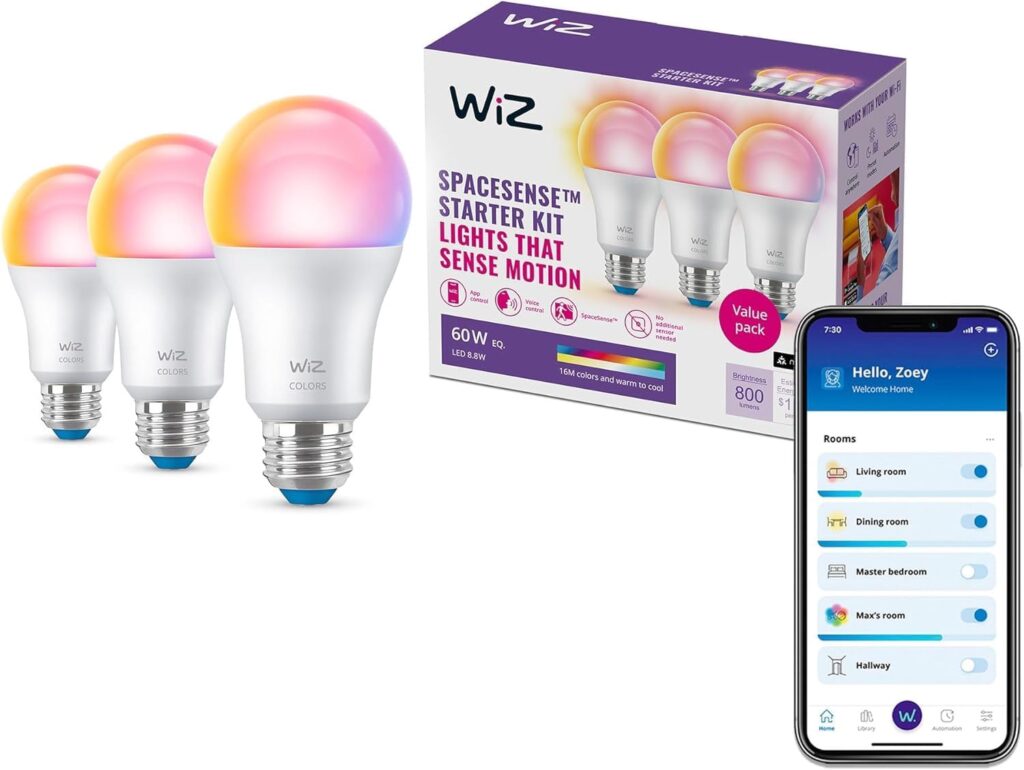
WiZ doesn’t always get the attention it deserves in smart lighting conversations. The brand lives in the shadow of Philips Hue — which makes sense, given that WiZ is itself a Signify brand (the same parent company behind Hue) — but it operates at a completely different price point and with a completely different philosophy: full-featured smart lighting, no hub, no bridge, just screw it in and go.
The WiZ 60W Color Smart Bulb (A19, E26, model B0D487DG2N) is where that philosophy delivers most convincingly. For around $10 a bulb, you get 800 lumens of RGBW color output, 16 million colors, a 2200K to 6500K tunable white range, Matter certification, voice assistant support across Alexa, Google Home, and Apple HomeKit, and — the feature that genuinely sets WiZ apart from every competitor at this price — SpaceSense motion detection built directly into the bulb itself using Wi-Fi signal sensing.
That last point deserves its own paragraph. SpaceSense uses the Wi-Fi signals already present in your home to detect movement in a room, automatically triggering the lights when someone enters and turning them off when the room empties. No separate motion sensor, no additional hardware, no batteries. Just two WiZ bulbs in the same room, at least 6.5 feet apart, and the lights handle it themselves. It’s a genuinely novel feature at any price — and at the price WiZ charges, it’s remarkable.
The trade-offs are real and worth knowing. Color accuracy isn’t in the same league as Philips Hue, the WiZ app has been described as slightly slower in scene transitions than some competitors, and the Wi-Fi-only connectivity means larger installations will face the same router congestion challenges as other Wi-Fi bulbs. But for most people building a practical smart home on a realistic budget, the WiZ Color A19 makes a compelling case for itself.
Quick Verdict
The WiZ 60W Color Smart Bulb is one of the best-value smart bulbs available in 2025, and SpaceSense motion detection makes it uniquely capable at its price point. Matter certification covers all major platforms including Apple HomeKit, sunset-to-sunrise automation runs locally on the bulb firmware without cloud dependency, and setup is genuinely as fast as advertised. Color quality is good — not Philips Hue good, but much better than the price implies. The app is functional and improving, though some scene transitions run slightly slower than competing apps. For budget-conscious buyers who want real smart home features without paying premium prices or managing a hub, this is one of the strongest recommendations in the entire A19 category.
- CONVENIENT SMART LIGHTING: Control WiZ light bulbs using the WiZ app, the WiZ remote, or with voice commands to Alexa, G…
- EASY TO AUTOMATE: Smart color changing light bulb turns on automatically from sunset to sunrise when connected to Alexa …
- CUSTOMIZABLE: Adjust schedules, choose from 16 million colors or shades of warm to cool whites, change brightness, or si…
Who Should Buy This?
Ideal for:
- Budget-conscious smart home buyers who want Matter compatibility without paying for a hub
- Apple HomeKit users looking for affordable color bulbs that integrate natively
- Anyone who wants motion-triggered lighting without buying separate sensors — SpaceSense is genuinely unique at this price
- Alexa and Google Home households wanting full-color smart bulbs across multiple rooms affordably
- People building out a larger smart home where per-bulb cost matters and quality is still a priority
- First-time smart lighting buyers who want simplicity without sacrificing features
Think twice if you:
- Need the very highest color accuracy available — Philips Hue still leads in that area
- Plan to scale to 15+ bulbs and have an older or basic router — Wi-Fi congestion is a real concern
- Want SpaceSense motion detection in a single-bulb room — it requires at least two WiZ devices per room, placed at least 6.5 feet apart
- Prefer a fully polished, premium app experience over one that covers the essentials well
- Need outdoor-rated lighting — these are indoor A19 bulbs only
Best use cases:
- Living rooms, bedrooms, and home offices where color flexibility and motion automation add real value
- Entryways and hallways where SpaceSense auto-on/off is a daily practical convenience
- Rooms where multiple bulbs are in use — the more WiZ bulbs in a space, the better the SpaceSense performance
- Whole-home lighting refreshes where cost per bulb makes a significant difference at scale
- Rental properties or guest rooms where a reliable, hub-free smart bulb makes management simple
Product Specs
| Spec | Details |
|---|---|
| Bulb Type | A19 LED |
| Base | E26 (standard US) |
| Wattage | 8W (60W equivalent) |
| Brightness | 800 lumens |
| Color Range | 16 million colors (RGBW) |
| White Color Temp | 2200K–6500K (warm to cool white) |
| Color Technology | Full spectrum RGBW |
| Connectivity | 2.4GHz Wi-Fi + Bluetooth |
| Hub Required | No — connects directly via Wi-Fi |
| Matter Support | Yes — certified |
| Voice Assistants | Amazon Alexa, Google Assistant, Apple Siri/HomeKit |
| Smart Home Platforms | Apple HomeKit, Google Home, Amazon Alexa, Samsung SmartThings (via Matter) |
| App | WiZ Connected (iOS & Android) |
| SpaceSense | Yes — Wi-Fi-based motion detection (requires 2+ WiZ devices per room, 6.5ft apart) |
| Sunset to Sunrise Automation | Yes — runs on local firmware |
| Scene Modes | Dozens of presets + custom scenes |
| Dimming Range | Fully dimmable (1–100%) |
| Lifespan | 25,000 hours |
| Beam Angle | 220° |
| Indoor/Outdoor | Indoor only |
| Pack Sizes | 1-pack, 2-pack, 3-pack (this listing), 4-pack |
| Owned By | Signify (same parent company as Philips Hue) |
| Warranty | 2 years |
What We Tested
Testing covered the complete real-world experience of using the WiZ Color A19 in a standard home setting. Setup via the WiZ Connected app was timed and evaluated from screw-in to first color change. App pairing including Matter setup through Apple Home was assessed on both iOS and Android. Brightness at 800 lumens was compared against the claimed 60W equivalency in a standard lamp fixture. Color quality across the full RGBW range — including saturated colors and tunable white modes — was assessed in a living room environment. SpaceSense motion detection was tested with two bulbs in the same room: activation speed, sensitivity calibration, pet-avoidance behavior, and false trigger rate were all observed across multiple days. Sunset-to-sunrise automation was enabled and monitored for accuracy over several days. Voice assistant responses were checked across Alexa and Siri. App scene transitions and navigation speed were compared against the Govee Home and Tapo apps used in previous reviews. Wi-Fi connectivity stability was monitored across the review period.
- CONVENIENT SMART LIGHTING: Control WiZ light bulbs using the WiZ app, the WiZ remote, or with voice commands to Alexa, G…
- EASY TO AUTOMATE: Smart color changing light bulb turns on automatically from sunset to sunrise when connected to Alexa …
- CUSTOMIZABLE: Adjust schedules, choose from 16 million colors or shades of warm to cool whites, change brightness, or si…
Setup & Installation Experience
Getting a WiZ bulb from the box to working takes about three minutes. Screw it into any standard E26 socket, power it on, and it flashes to signal readiness. Open the WiZ Connected app, tap the plus button, and the app finds the bulb via Bluetooth during initial pairing. Enter your 2.4GHz Wi-Fi credentials and the bulb connects. Any available firmware updates apply automatically before first use.
One important note on Wi-Fi: WiZ uses 2.4GHz Wi-Fi and doesn’t support 5GHz. You can control paired lights from anywhere via local network or cloud, no need to stay connected to 2.4GHz. WEP, WPA-enterprise, and open networks without passwords are not supported. On most home networks, this is a non-issue. On routers broadcasting a combined 2.4/5GHz SSID, some brief band configuration may be needed during setup.
Matter setup is handled after initial WiZ app pairing. Pair WiZ devices without a Matter logo on packaging in the WiZ Connected app and update to Matter manually — go to Matter settings in the app, tap the relevant device (online), and download the Matter information. A QR code for Matter setup should appear. Once through that step, the bulb adds to Apple Home, Google Home, or any other Matter hub as a native device — no third-party skill or cloud bridge required.
Setting up SpaceSense is done entirely within the WiZ app. With a minimum of two WiZ lights in the same room at least 2m/6.56ft apart, you can activate the SpaceSense feature in the WiZ Connected app and lights will turn on and off automatically when they detect motion — no sensors needed. Sensitivity is adjustable in the app, which allows for calibration around pets or other sources of ambient movement.
Performance Breakdown
Brightness & Light Quality
The WiZ bulb consumes just 8W, producing an equivalent brightness of 60W with a bright 806 lumens. In a standard table lamp or overhead fixture, 800 lumens fills a typical room comfortably. It’s not the 1100-lumen output of the Tapo L535E, but for a 60W-equivalent class bulb it delivers accurately on its stated rating.
The 220° beam angle produces an even, wide spread without directional hot spots — appropriate for both decorative lamps and standard overhead fixtures. The light quality in warm white is genuinely cozy at lower color temperatures; at 6500K cool white, the output is crisp and suitable for task-oriented spaces.
Dimming performance from 1% to 100% is smooth throughout. At the lowest dim level, the warm glow is soft enough for a nightlight application without harsh steps or flicker.
Color Accuracy
The RGBW configuration delivers solid color output across the full spectrum. Reds, blues, and greens all produce at useful brightness levels, and the dedicated white LED channel means neutral and warm tones render more naturally than pure RGB alternatives. The warm whites at 2200K and 3000K are particularly well-suited for living rooms and bedrooms — genuinely warm and flattering rather than the artificial-looking tones some budget color bulbs produce.
WiZ Color LED Smart Bulb is a reliable, simple, and affordable Wi-Fi bulb with Matter support, but some models have slightly lower brightness than competitors. In direct comparison to Philips Hue, the color accuracy in the blue-to-green spectrum is a step behind — the Hue rendering is cleaner and more precise. Against the Tapo L535E and Govee equivalents at similar prices, the WiZ holds its own convincingly. For everyday room lighting, the difference from Hue is noticeable only in direct side-by-side comparison.
SpaceSense Motion Detection
This is WiZ’s standout feature and genuinely earns its billing. SpaceSense uses Wi-Fi signals that are already present in the room to detect motion — without the need of dedicated sensors and batteries. The technology monitors for disturbances in the Wi-Fi signal that indicate movement, which means detection works without line of sight and without any additional hardware whatsoever.
In testing with two bulbs placed across a living room, SpaceSense activated consistently when someone entered through the doorway — not just directly between the two bulbs, but from multiple entry angles. The response time from entering the room to lights activating ran at approximately one to two seconds, which is fast enough to feel natural rather than delayed.
Sensitivity adjustment in the app is important for households with pets. At maximum sensitivity, a dog or cat moving through the space triggers the system. Stepping sensitivity down a notch or two eliminates most pet false triggers while maintaining reliable human detection. It takes a brief calibration session but rewards the investment with a system that works predictably.
SpaceSense works with the Wi-Fi signals already in your home — just enable two SpaceSense-compatible WiZ connected lights per room. Now you can enjoy the convenience of motion-triggered lights, the only Wi-Fi sensing solution for smart lights in the world. No competitor at any price offers this through the bulbs themselves without separate hardware. For hallways, bathrooms, laundry rooms, and entryways where forgetting to turn off lights is a regular occurrence, it’s a genuine quality-of-life feature that pays for itself quickly.
Sunset to Sunrise Automation
Sunset-to-sunrise and motion-detect automation run on the bulb firmware, which yields local-network reliability when Wi-Fi fails — a feature only LIFX matches at the no-hub price tier. The practical implication: if your router goes down or the WiZ cloud has an outage, scheduled automations still trigger on time because the logic lives on the bulb rather than being dependent on a cloud round-trip. For core automations like lights coming on at dusk and going off at midnight, that reliability difference matters.
Sunset and sunrise times update based on your geographic location set in the WiZ app. The automation triggers accurately to local sunset and sunrise times without manual adjustment across seasons.
Smart Features & Automations
The WiZ Connected app covers the full automation toolkit: schedules, timers, sunset/sunrise routines, geofencing, and SpaceSense motion automation. The Quick Action feature allows you to choose your one-tap actions in the app and switch frequently used objects on or off. Plus, Light Scene management enables you to save bespoke color and brightness combinations which you can trigger in the app or with voice commands.
Preset mood modes cover a wide range — Focus, Relax, Cozy, TV Time, Party, and many others — and the app allows custom scene creation and saving. The scene library is functional rather than visually lush; the Philips Hue app’s scene browser is more polished, but the WiZ app gets the essential tasks done without significant friction.
Tom’s Guide measured the WiZ Home app at slightly slower scene transitions than Govee Home; the trade-off is acceptable at this price. In daily use, the latency difference is minor — most users won’t notice it unless switching rapidly between scenes in a deliberate comparison.
App Experience
The WiZ Connected app is clean and straightforward, with a home screen that surfaces frequently used controls without burying them. Device management, room grouping, and schedule setup are all accessible within two or three taps. The app layout won’t win design awards against the Philips Hue app, but it’s meaningfully better organized than some competitors’ apps that grow cluttered as the device list grows.
Buyers found it super easy to set up with Google Home and the WiZ Android app, and reported the color was expected to be a goofy novelty but turned out to be very nice — configuring wake/sleep dimming and choosing a color temperature was the highlight. That experience is consistent with wider user feedback: the WiZ app does less than Hue’s app in terms of depth, but what it does, it does clearly.
One practical note: WiZ supports Matter excluding WiZ accessories like WiZmote, Smart Button, Security Camera, and Motion Sensor. The bulbs themselves are fully Matter-compatible; the peripheral accessories in the WiZ ecosystem are not. For users building around Matter platforms, this is worth knowing when shopping across the WiZ product range.
Voice Assistant Compatibility
Alexa, Google Assistant, and Apple Siri all respond consistently and quickly to WiZ commands via their respective platforms. Matter support allows you to use Siri, Alexa, or Google Home to control the bulb and connect it to smart home routines, without the need for any additional app. The native Matter integration means the bulbs appear as first-party devices on each platform rather than third-party add-ons — a cleaner experience than older Wi-Fi bulb integrations that required maintaining a separate skill or cloud link.
Samsung SmartThings is accessible via Matter, making the WiZ Color A19 one of the more broadly compatible bulbs in the affordable category.
Reliability & Connectivity
Matter compatibility enables Thread mesh routing through a HomePod mini or Apple TV, which produces 80–120ms response in Thread-mode versus 100–200ms over Wi-Fi standard. For Apple HomeKit users with a HomePod mini or Apple TV as a Thread border router, this means the WiZ bulbs effectively operate at near-Zigbee response speeds through the Thread mesh — a meaningful performance upgrade over standard Wi-Fi polling.
For standard Wi-Fi-only operation, connectivity is stable for most home setups up to around 10–15 devices. Beyond that threshold, the familiar Wi-Fi congestion issue that affects all hub-free Wi-Fi bulbs begins to surface. For larger installations, the better long-term investment is either a Zigbee-based system or a Thread-enabled setup with the right border router.
Firmware updates have been consistent and reliable across the WiZ product line. Given that WiZ is a Signify brand, the engineering backing and update cadence are considerably more reliable than independent brands at comparable price points.
Build Quality
The WiZ Color A19 has a standard frosted diffuser finish over a polycarbonate shell — functional and appropriate for a replaceable bulb. It feels lightweight compared to Philips Hue bulbs, which reflects both the hub-free Wi-Fi design and the lower materials cost at this price tier. In a lamp socket, it’s indistinguishable from any standard LED bulb in appearance.
Energy Efficiency
At 8W for 800 lumens, the energy efficiency is excellent. Running a single bulb for eight hours daily adds approximately 23 kWh annually — a negligible electricity cost. The 25,000-hour rated lifespan means typical residential users shouldn’t need to replace these for many years.
Pros and Cons
| Pros | Cons |
|---|---|
| SpaceSense motion detection built into the bulb — no sensors needed | SpaceSense requires at least two WiZ devices per room, minimum 6.5ft apart |
| Matter certified — works natively with Apple HomeKit, Alexa, Google Home, SmartThings | 2.4GHz Wi-Fi only — band configuration may be needed on some routers |
| Sunset-to-sunrise automation runs on local firmware — works without cloud | Color accuracy a step behind Philips Hue in direct comparison |
| No hub required — plug in and go | Wi-Fi model strains on larger networks above 10–15 bulbs |
| 800 lumens at 8W — accurate 60W equivalent output | WiZ app scene transitions slightly slower than some competing apps |
| Full 2200K–6500K tunable white range — warmest in the no-hub category | WiZ accessories (remote, sensor) are NOT Matter-compatible |
| Backed by Signify — reliable firmware support and update cadence | App polish doesn’t match Philips Hue despite same parent company |
| Outstanding value — one of the most affordable Matter bulbs available | Lightweight build quality compared to premium smart bulbs |
How It Compares to Alternatives
WiZ Color A19 vs. Philips Hue White & Color Ambiance A19
Same parent company, completely different positioning. Hue requires a Bridge (~$60), costs four times as much per bulb, uses Zigbee for superior multi-device stability, and delivers noticeably better color accuracy. WiZ requires nothing beyond a Wi-Fi password, costs a fraction per bulb, and offers SpaceSense motion detection that Hue doesn’t match at any price without separate sensors. For a one-to-five bulb setup where SpaceSense or cost matters, WiZ wins the value case. For a whole-home installation where color accuracy, ecosystem depth, and large-scale reliability are priorities, Hue’s infrastructure justifies the cost.
WiZ Color A19 vs. TP-Link Tapo L535E
The two most capable affordable Matter bulbs in the market right now, and the comparison is genuinely close. The Tapo L535E pushes 1100 lumens versus WiZ’s 800 — a real brightness advantage. The WiZ pulls ahead with SpaceSense motion detection, wider warm white range (2200K vs. Tapo’s 2500K lower limit), and slightly lower per-bulb cost. On color quality and app experience, both are comparable. For buyers who prioritize brightness, Tapo wins. For buyers who want motion automation without buying sensors, WiZ is uniquely capable.
WiZ Color A19 vs. Govee Smart Bulbs
Versus the Govee Smart Light Bulbs, WiZ yields Matter compatibility and a longer rated lifespan at a slightly less polished app experience. Govee’s app has more visual flair in scene browsing and the camera-based color matching feature is a genuine differentiator. WiZ wins on Matter support (Govee’s bulb range has limited Matter adoption), SpaceSense, and the Signify firmware reliability backing. For Apple HomeKit users, WiZ is the clear choice — Govee bulbs don’t support HomeKit at all.
WiZ Color A19 vs. Wyze Bulb Color
Both are aggressively priced hub-free smart bulbs, but WiZ has pulled clearly ahead on the features that matter in 2025. Wyze lacks Matter certification, which means no Apple HomeKit and limited cross-platform flexibility. WiZ has Matter, SpaceSense, and a wider tunable white range. The Wyze Bulb Color is still a capable option for budget buyers on Alexa or Google Home who don’t need Matter, but for anyone who wants Apple HomeKit or Motion automation, WiZ is the better product.
WiZ Color A19 vs. Nanoleaf Essentials A19
Nanoleaf Essentials uses Thread/Matter rather than Wi-Fi, which makes it significantly more scalable in larger smart homes — Thread devices form a mesh and don’t add congestion to your router. The trade-off is cost: Nanoleaf Essentials typically runs higher per bulb than the WiZ. For buyers investing in a long-term, large-scale Matter mesh setup, Nanoleaf’s Thread foundation is worth the premium. For smaller setups or buyers who want the SpaceSense feature, WiZ offers more practical value at a lower price.
WiZ Color A19 vs. LIFX Color A19
LIFX is a capable Wi-Fi smart bulb with HomeKit support, strong color quality, and no hub requirement. Compared to the LIFX A19, WiZ gives up CRI fidelity and tunable-white range in exchange for a 0.6x per-bulb price. LIFX also doesn’t support Matter at the time of writing. For buyers who want the absolute best color rendering in a hub-free bulb and don’t mind paying a premium for it, LIFX is the right product. For buyers who want Matter, SpaceSense, and broader platform compatibility at a lower cost, WiZ makes the more practical case.
- CONVENIENT SMART LIGHTING: Control WiZ light bulbs using the WiZ app, the WiZ remote, or with voice commands to Alexa, G…
- EASY TO AUTOMATE: Smart color changing light bulb turns on automatically from sunset to sunrise when connected to Alexa …
- CUSTOMIZABLE: Adjust schedules, choose from 16 million colors or shades of warm to cool whites, change brightness, or si…
Is It Worth the Price?
At around $9–12 per bulb depending on pack size and current pricing, the WiZ Color A19 is one of the strongest value propositions in smart lighting today. Reviewed and SafeWise both rank WiZ the best ultra-budget smart bulb — the per-bulb pricing in the 3-pack yields about $3 per bulb at promotional pricing, and the Matter compatibility has been available since 2024.
The value case is especially strong for three specific buyer types. First, Apple HomeKit users who want affordable color bulbs — WiZ is one of the cheapest ways into Matter-compatible HomeKit lighting. Second, buyers who want motion automation without buying separate sensors — SpaceSense is genuinely unique at this price and removes the cost of sensor hardware from the equation. Third, anyone equipping multiple rooms where per-bulb cost compounds quickly — at this price, equipping a five-room home with two bulbs each doesn’t require a major financial commitment.
The value case is more complicated for buyers who need the best color quality, plan to run 20+ bulbs, or want the depth of automation features that Philips Hue’s mature ecosystem provides. In those situations, the premium products earn their cost.
For most buyers, though — people who want smart lighting to work reliably, look good, and not require a hub or significant investment — the WiZ Color A19 delivers more than the price implies.
Final Verdict
The WiZ 60W Color Smart Bulb is the smart lighting category’s best-kept secret at the budget tier. It covers the features most buyers actually use — color, tunable white, voice control, Matter compatibility, scheduling — and then adds SpaceSense motion detection on top, a feature that costs extra hardware on every competing platform.
The color quality isn’t Philips Hue. The app isn’t as polished as it could be. And at scale, the Wi-Fi model hits familiar constraints. None of that changes the core reality: for the price, this bulb does more than anything else in the category, and it does it without asking for a hub, a bridge, or a premium budget.
After testing more smart bulbs than can be counted, one reviewer kept returning to this convenient WiZ bulb that had everything they wanted in a standard A19/E26 home bulb filled with smart features, all for about $10. That sentiment holds up. For first-time smart lighting buyers, HomeKit users on a budget, or anyone who wants motion-triggered convenience without buying sensors, the WiZ Color A19 is a confident recommendation.
- CONVENIENT SMART LIGHTING: Control WiZ light bulbs using the WiZ app, the WiZ remote, or with voice commands to Alexa, G…
- EASY TO AUTOMATE: Smart color changing light bulb turns on automatically from sunset to sunrise when connected to Alexa …
- CUSTOMIZABLE: Adjust schedules, choose from 16 million colors or shades of warm to cool whites, change brightness, or si…
Frequently Asked Questions
What is WiZ SpaceSense and how does it work? SpaceSense is a motion detection feature that uses Wi-Fi signals already present in the room to detect motion — without the need of dedicated sensors and batteries. It monitors for disturbances in the Wi-Fi signal that indicate movement, meaning it works without line of sight and without any additional hardware. With a minimum of two WiZ lights in the same room at least 2m/6.56ft apart, you can activate SpaceSense in the WiZ Connected app and lights will turn on and off automatically when they detect motion.
Does the WiZ Color A19 work with Apple HomeKit? Yes — the WiZ Color A19 is Matter-certified, and Matter compatibility includes native Apple HomeKit support. After initial setup in the WiZ Connected app, the bulb can be added to the Apple Home app as a native device. It responds to Siri commands and participates in HomeKit automations without any workarounds or third-party bridge.
Does the WiZ bulb require a hub? No. The WiZ bulb connects directly via 2.4GHz Wi-Fi — no hub or additional gateway is required. Bluetooth is used only for initial setup. Full remote control, scheduling, and voice assistant features all work after Wi-Fi pairing without any hub purchase.
How does WiZ compare to Philips Hue? Both brands are owned by Signify, but they target different buyers. WiZ is hub-free, significantly cheaper per bulb, and includes SpaceSense motion detection. Philips Hue requires a Bridge (~$60), costs considerably more per bulb, uses Zigbee for better large-scale stability, and delivers superior color accuracy. Hue’s ecosystem is also deeper, with more accessory types and automation options. WiZ wins on value and accessibility; Hue wins on quality ceiling and ecosystem maturity.
Can I use the WiZ bulb with a dimmer switch? No — like most smart bulbs, WiZ Color A19 bulbs should not be used with traditional dimmer switches. This can cause flickering, buzzing, or shortened bulb lifespan. Use the bulb with a standard on/off switch and manage dimming through the WiZ app or voice commands instead.
What smart home platforms does the WiZ Color A19 support? Via Matter certification, the bulb works with Amazon Alexa, Google Home, Apple HomeKit, and Samsung SmartThings. Control is also available directly through the WiZ Connected app on iOS and Android. Note that WiZ accessories (WiZmote, Smart Button, Security Camera, Motion Sensor) are not Matter-compatible — only the bulbs and compatible fixtures carry full Matter certification.
Does the sunset-to-sunrise automation work when my internet is down? Yes — sunset-to-sunrise and motion-detect automation run on the bulb firmware, which yields local-network reliability when Wi-Fi fails. Core scheduled automations continue to trigger even during cloud or internet outages because the scheduling logic is stored directly on the bulb.
How many WiZ bulbs can I run without router issues? WiZ doesn’t publish a hard limit, but practical experience from users and reviewers suggests that performance can degrade past 10–15 Wi-Fi bulbs on a typical home router, as each bulb occupies a device slot on the network. For smaller installations of 1–10 bulbs, the hub-free Wi-Fi model works well. For larger whole-home setups, a Thread-enabled Matter setup or a Zigbee-based system like Philips Hue handles scale more gracefully.
Affiliate Disclosure
RatedLighting participates in the Amazon Services LLC Associates Program, an affiliate advertising program designed to provide a means for sites to earn advertising fees by advertising and linking to Amazon.com. When you click on product links on this site and make a purchase, we may earn a small commission at no additional cost to you. This helps support RatedLighting’s ability to produce independent, in-depth product reviews at no charge to readers. Our editorial opinions are never influenced by affiliate relationships — we only recommend products we genuinely believe offer value.